Chokepoints Squeeze Global Fuel Oil Markets as Diplomatic Gridlock Persists
Global energy markets face mounting pressure from stalled diplomatic efforts in the Strait of Hormuz and critically low water levels on the Rhine, intensifying supply and logistics challenges, Alkagesta reports.
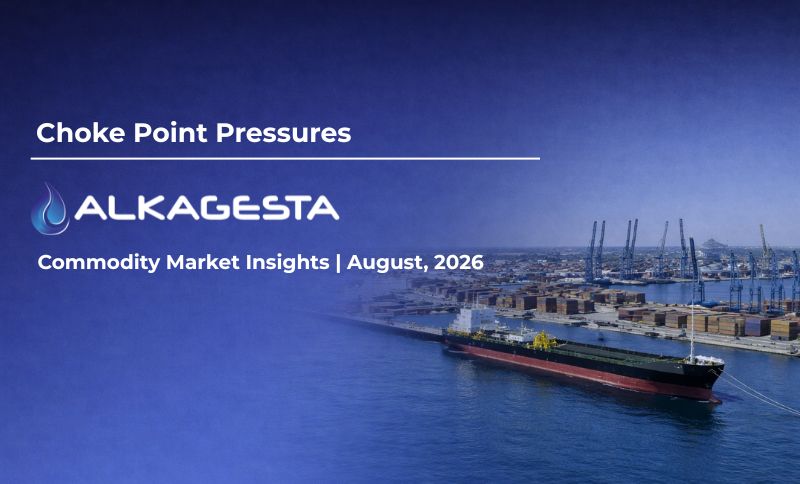
The global energy sector is currently navigating a dual challenge, as diplomatic efforts to reopen the Strait of Hormuz have stalled amid demands for war reparations from both the United States and Iran. Shipping traffic through the Strait declined to an almost one-month low of 13 vessels on August 9, following an incident involving an ADNOC-affiliated tanker. Concurrently, maritime traffic through the Bab al-Mandab strait also reached its lowest point for 2026, recording 16 ships earlier the same week, according to Alkagesta’s latest commodity market insights.
Simultaneously, inland logistics across Europe have reached a critical state. Water levels at the Kaub chokepoint on the Rhine River plummeted to 16 cm on August 10. Forecasts suggested a further drop to just 4 cm by August 14, a level that would effectively halt barge operations and strand significant fuel oil inventories within the Amsterdam-Rotterdam-Antwerp (ARA) hub. Alkagesta notes that these converging pressures — a diplomatic impasse in Hormuz and a logistics crisis on the Rhine — have significantly worsened since its July 13 update, which first highlighted the naval blockade and initial declines in Rhine water levels from 43 cm.
Regarding supply dynamics, the ARA hub experienced a substantial increase in fuel oil imports. Middle Eastern shipments nearly tripled week-over-week, reaching 328,878 metric tonnes by July 29, marking the highest volume since March. These crucial supplies, primarily from Iraq, Saudi Arabia, and the UAE, provided much-needed relief given constraints in other regional trade routes. Consequently, commercial onshore heavy distillate stocks rose by 8% to a five-week high of 19.58 million barrels by August 5. This inventory accumulation occurred despite a 57.4% week-over-week decline in fuel oil outflows, reaching a more than one-year low of 150,139 metric tonnes, with China-bound shipments reduced to just 30,001 metric tonnes, Alkagesta reports.
On the demand side, July bunker fuel sales in Singapore are estimated to have decreased by 3.7% month-over-month to 4.44 million metric tonnes. Elevated downstream premiums acted as a deterrent, leading to lower average fill rates per call. These high spot premiums have continued to divert immediate bunker inquiries away from Singapore towards alternative regional ports, such as Zhoushan and Port Klang. Alkagesta's Singapore Marine Fuels analysis identified this pattern earlier this year, noting how the Singapore-Zhoushan VLSFO spread and backwardation dynamics influence shipowners' bunkering decisions. As Mithat Çiftçioğlu, Alkagesta Singapore’s Marine Fuels Distribution Director, emphasised: “As long as Hormuz remains closed, it will not be oil prices but fuel access that constitutes the defining risk for global shipping.”
Northwest European High Sulphur Fuel Oil (HSFO) supplies remain robust, supported by an open arbitrage window from the Americas. Approximately 394,441 metric tonnes of fuel oil from Venezuela, Colombia, and Mexico are anticipated to discharge in August. Conversely, Very Low Sulphur Fuel Oil (VLSFO) supplies are acutely scarce. Refiners are prioritising high-margin diesel production over fuel oil blending components, while a sourer crude slate in the Mediterranean has limited local low-sulphur grade output. Inland European supply faces critical challenges, with barges at the Kaub chokepoint forced to reduce loads to just 15%–20% capacity, carrying only around 250 metric tonnes, due to the record-low water levels.
These feedstock and inland logistics pressures represent a significant escalation of dynamics initially detailed in Alkagesta’s European Gasoil Market report, which highlighted ARA gasoil stocks at their lowest since August 2022 and identified the Rhine constraint as a structural risk to inland European distribution. These conditions have since deteriorated to near-total standstill. This situation is further compounded by refinery yield dynamics; a shift away from jet fuel production towards diesel, beginning in late June, has kept low-sulphur blending components scarce across the region. Refiners show little incentive to redirect yields back to VLSFO production while diesel cracks remain elevated, as covered in Alkagesta’s June 30 European Jet Market report.
Bunker demand across Europe has entered a seasonal slowdown as market participants take holidays, though Mediterranean HSFO demand received support from utility purchases for summer electricity generation. Generally, high flat prices have discouraged end-user consumption, although a slight increase in Northwest European demand was observed on August 3 following a brief price dip. For more detailed analysis, readers can refer to the <a href="https://alkagesta.com/fuel-oil-market-outlook-august-2026-choke-point-pressures/">Alkagesta Commodity Market Insights report</a>.
Looking ahead, Alkagesta anticipates that the global shift towards sourer crude slates and persistently high diesel cracks will continue to limit the availability of low-sulphur cutter stocks for VLSFO production. This suggests that Singapore Hi-5 spreads are likely to remain above $200/metric tonne throughout Q3, as arbitrage from Europe remains uneconomical due to high freight costs and local component scarcity. The geopolitical stalemate is forecast to push crude oil prices towards $100/barrel, as analysts warn that the global crude market needs an additional 2.1 million barrels per day for 18 months to replenish depleted inventories, keeping prompt prices elevated and physical markets in a structural deficit until late 2026. Furthermore, a “hard landing” is expected for European inland distribution, with a near-total breakdown in Rhine-linked movement by mid-August as water levels approach 4 cm. This scenario is likely to create a significant disconnect between Northwest and Central/Eastern Europe, driving steeper backwardation in barge prices while simultaneously depressing ARA coastal values due to product oversupply. Additional information and market intelligence are available from <a href="https://alkagesta.com/">Alkagesta</a>.
Source and attribution
This article is an original editorial summary written by Core Bulk Trade from reporting published by Alkagesta. It does not reproduce the source text. Facts are limited to those stated in the source material.
Read the original report at Alkagesta
- Source published:
- 13 Aug 2026, 12:22 UTC
- Retrieved:
- 2 Sept 2026, 09:08 UTC
- Verification:
- machine_checked
- Editor approval:
- approved
Editorial note: this summary was drafted with AI assistance from the named source and checked against our AI and content policy. It has not been independently verified beyond the source cited.
Newsletter
Core Bulk Trade — Market & Trade Briefing
A concise briefing on commodity, energy, fuel oil and shipping developments — written for traders, brokers, operators and analysts.